The workshop formed part of the Climate Impact and Data Enhancement Project, which aims to strengthen the analysis of greenhouse gas (GHG) emissions within Saint Lucia
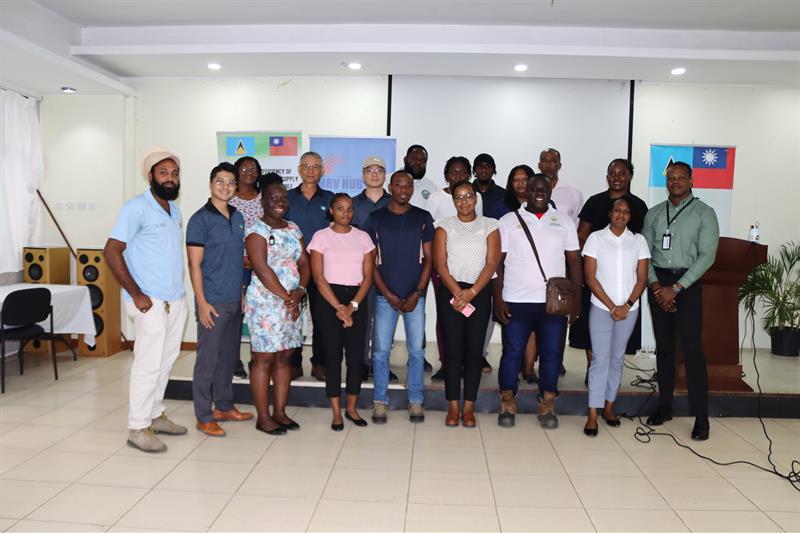 Key stakeholders, including farmers, extension officers and policymakers, attended a Data Analysis Workshop recently to present and discuss the analysis of greenhouse gas (GHG) emissions data from crop production. The workshop aimed at familiarizing participants with the data analysis results, key findings, and underlying assumptions informing the estimation of GHG emissions.
The workshop formed part of the Climate Impact and Data Enhancement Project, which aims to strengthen the analysis of greenhouse gas (GHG) emissions within Saint Lucia’s agricultural sector, supporting national and international transparency.
The workshop was hosted by the Ministry of Agriculture, Fisheries, Food Security and Climate Change, in collaboration with the Caribbean Cooperative Measurement, Reporting & Verification Hub (CCMRVH), and Taiwan Technical Mission (TTM) in Saint Lucia, and was held on Tuesday, January 27, 2026, in the Union Orchid Gardens conference room.
During the three-hour session, stakeholders reviewed the analyzed results, discussed the analysis of the data and proposed actions, and strengthened communication and coordination across the agricultural sector to support improved GHG reporting and informed climate action.
During his remarks at the workshop, Mr. Daniel Lee, Chief of Mission at the Taiwan Technical Mission (TTM) in Saint Lucia, said the workshop marked an important milestone under the Vegetable and Fruit Production and Marketing Enhancement Project (Phase II), commonly known as the Seven Crops Project. He noted that, over the years, the project has evolved from a primary focus on production techniques into a more integrated approach — one that brings together climate resilience, digital data systems, and policy-relevant evidence.
“Our collaboration with the Caribbean Cooperative Measurement, Reporting and Verification Hub further strengthens this effort,” Mr. Lee said. “Together, we are working to build agricultural systems that are measurable, reportable, and verifiable — systems that can support national climate reporting needs while remaining practical and relevant for farmers and extension services. This partnership positions Saint Lucia as an important example within the Caribbean region of how climate-smart agriculture and data governance can advance hand in hand.”
Mr. Lee said the workshop was not about presenting a final result, but an opportunity to learn together by examining what works in the field, discussing how data collection can be simplified and improved, and ensuring that these approaches remain farmer-friendly and scalable.
He thanked the Ministry of Agriculture, the CCMRV Hub, and all related partners for their trust and collaboration. He also thanked the extension officers and farmers, whose feedback and participation continue to guide the direction of the project.
Mr. Crispin d’Auvergne, Executive Director of the Caribbean Cooperative Measurement, Reporting & Verification Hub (CCMRVH), said that despite agriculture being the bedrock of civilization, it is often taken for granted, especially in post-agrarian societies that are more industrial, service, and knowledge-based.
“(Agriculture) has enabled the transition from a nomadic existence to permanent settlements and to the birth of nations, while simultaneously driving technological innovation, as people have toiled with, and against, the elements to produce food and raw materials to satisfy their needs,” Mr. d’Auvergne explained. “In today’s warming world, climate change is tipping the scale in favour of the elements, ironically, with assistance from agricultural greenhouse gas emissions. In an effort to level the playing field, humankind is being forced to adapt and innovate and to apply climate-resilient, low-emission approaches.”
Mr. d’Auvergne said the Climate Impact & Data Enhancement project aims to improve data collection for agricultural GHG emissions by comparing production results between two conventional farm plots and two hoop greenhouses. The field experiments have also incorporated the use of solar-powered and fuel-powered water pumps.
“What we are doing today is not merely an academic or theoretical exercise,” he emphasized. “Rather, the outcomes should inform national agricultural policy and practice and strengthen climate reporting on future mitigation and adaptation strategies.”
He added that the CCMRV Hub appreciates partnering with the Taiwan Technical Mission in Saint Lucia and with the Ministry of Agriculture, Fisheries, Food Security and Climate Change on the Climate Impact and Data Enhancement Project.
“The Taiwan Technical Mission contributes hands-on agricultural innovation, infrastructure, and technical support,” Mr. d’Auvergne said. “I express our deepest appreciation to Mr. Daniel Lee and his team at the Taiwan Technical Mission for providing this opportunity to collaborate, and for the excellent work in overseeing the field and greenhouse trials.”
Meanwhile, Ms. Benise Joseph, Deputy Director of the Caribbean Cooperative Measurement, Reporting and Verification Hub (CCMRVH), who facilitated the workshop, said: “The workshop was an important step in strengthening local knowledge with empirical evidence to support climate adaptation and mitigation efforts in the agriculture sector. The high level of engagement highlighted the importance of data in enabling better decision-making and more effective planning.”
The first workshop under the project was held in the Union Orchid Gardens conference room on Tuesday, July 8, 2025, while the second was held in the National Skills Development Centre’s Vieux Fort location on Wednesday, July 9, 2025. A subsequent workshop was held in August, while a demonstration was held at the TTM’s farm at Union in November.